
Why Modern Roofs Fail in Moderate Winds
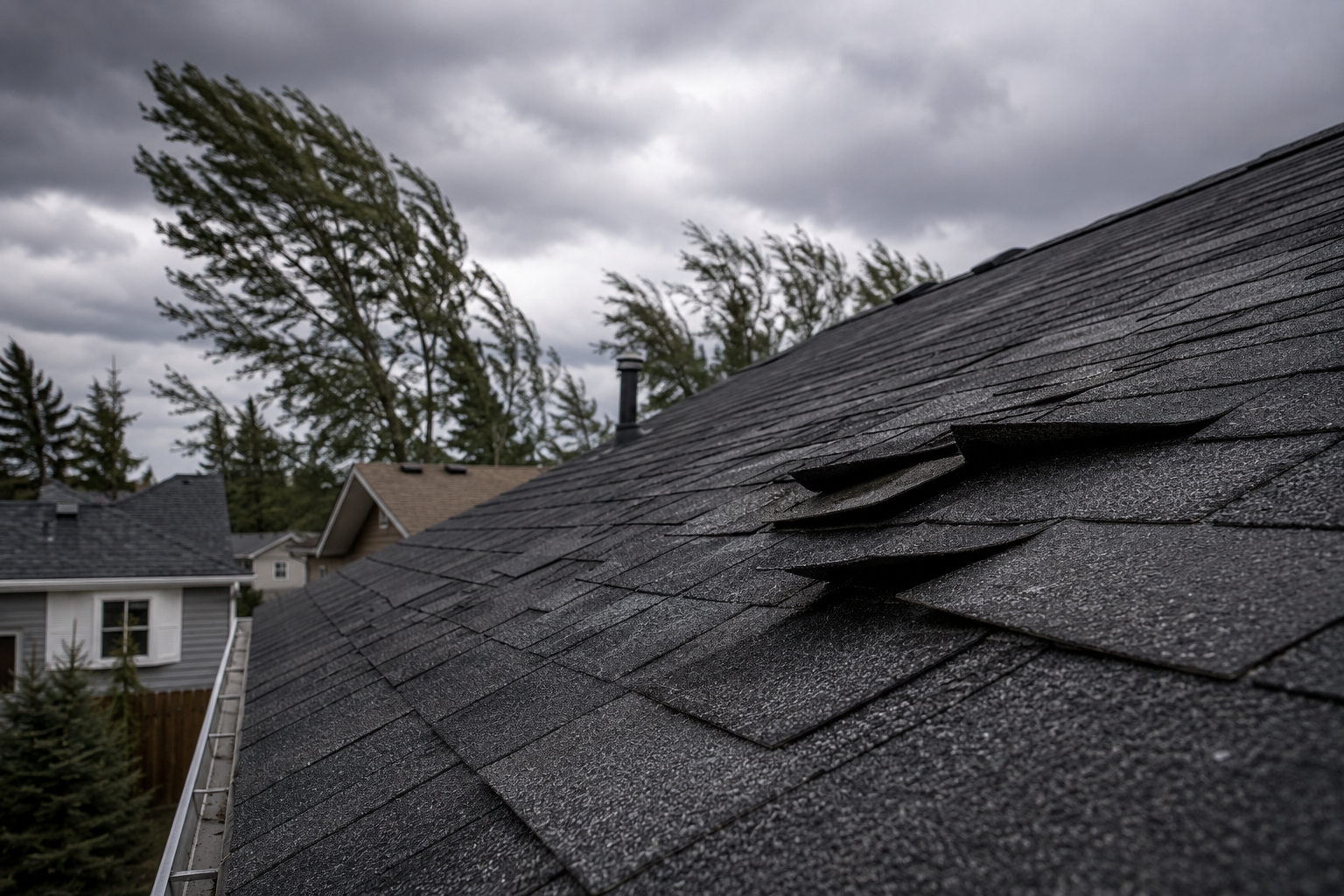
Short answer: Most modern roofs fail in moderate winds not because the materials are weak, but because of how wind actually works and how the roof was installed. Wind flowing over a roof creates suction, not just a push. That suction, called uplift, pulls shingles upward. When the factory sealant has not bonded yet, or the nails were placed wrong, even a 50 to 60 km/h gust can break the seal at the edges and start peeling shingles off. Once one shingle lifts, it acts like a lever and the failure spreads.
In other words, a shingle rated for 150 km/h winds can still blow off at half that speed if it was installed in cold weather, nailed too high, or fastened with too few nails. The rating is a lab number. Real roofs fail at the weak points.
Here is exactly why it happens, and how to tell if your roof is at risk.
 The Real Reasons, at a Glance
This table sums up the whole article. Each cause is explained in detail below.
| Cause of Failure | Why It Matters |
|---|---|
| Wind creates suction (uplift) | Pulls shingles up, not just sideways |
| Broken or unsealed adhesive strip | The shingle’s main defence is gone |
| Cold-weather installation | Sealant may not bond for weeks |
| Nails placed too high | Shingle held by one layer, not two |
| Too few nails | 4 or 6 nails required, installers use fewer |
| Edges and corners | Highest uplift pressure on the whole roof |
| Age of the roof | Sealant weakens after 4 to 5 years |
| Wrong shingle for the wind zone | Thin 3-tab shingles fail far sooner |
Wind Does Not Push Your Roof Off. It Sucks It Off.
This is the part almost nobody understands, and it changes everything.
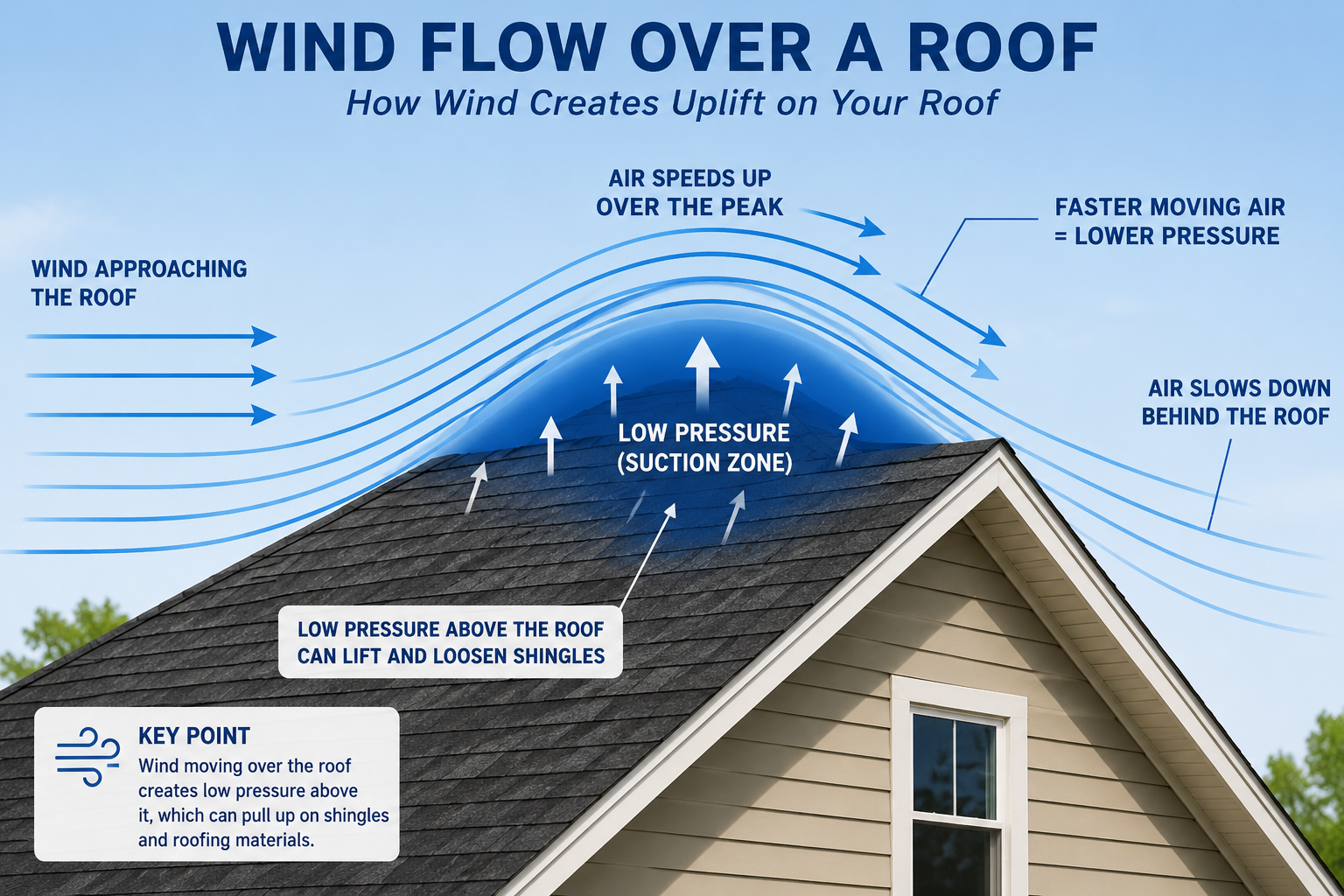
When wind hits your house, two forces act on the roof. The first is positive pressure, the direct push against the side facing the wind. The second, and the more dangerous one, is negative pressure, also called suction or uplift.
As wind speeds up flowing over the curved surface of your roof, the air pressure above the roof drops. This is Bernoulli’s principle, the same effect that lifts an airplane wing. The low pressure above the roof acts like a vacuum and pulls the shingles upward, away from the deck.
So the roof is not being blown off from the side. It is being sucked off from above. That is why shingles can lift on the sheltered side of a house, and why a roof can fail in winds that feel far from extreme.
 Wind Speed and Damage: What Actually Happens
You do not need a hurricane. Damage starts far lower than most homeowners think, especially on a roof that already has a weak point.
| Wind Speed | What Can Happen |
|---|---|
| 60 to 75 km/h (moderate) | Unsealed or aging shingles start lifting |
| 75 to 95 km/h (strong breeze) | Edges peel, creasing begins on older roofs |
| 95 to 120 km/h (gale) | Missing shingles, exposed underlayment |
| 120 km/h and above | Widespread loss, deck and flashing damage |
On the Canadian prairies, gusts in this range are a normal part of the year. A Calgary chinook can send warm winds ripping across rooftops well into the moderate and strong range. That is enough to find any weakness an installer left behind.
The Seal Is the Secret. When It Fails, the Roof Fails.
Asphalt shingles hold on in two ways. Understanding both explains almost every wind failure.
The first is the nails, the mechanical connection to the roof deck. The second is a strip of adhesive on the underside of each shingle, applied at the factory. After installation, the sun warms the shingles and activates that strip, gluing each row to the one below it.
When both work together, the roof is strong. When the seal is missing or broken, the shingle is only held by nails at the top, and the bottom edge is free to flap. Wind gets underneath, and the peeling begins.
| Defence | How It Works | How It Fails |
|---|---|---|
| Nails | Mechanical hold to the deck | Wrong placement, too few, overdriven |
| Sealant strip | Sun-activated glue between rows | Cold install, dust, age, defect |
Here is the key point for Canada: the sealant needs warmth and time to bond. A roof installed in cold weather may not seal for days or even weeks. Until it does, the wind resistance is nowhere near the number on the box.
Why Cold-Climate Installation Is a Major Cause
This is the factor most articles ignore, and it matters most in places like Alberta and Saskatchewan.
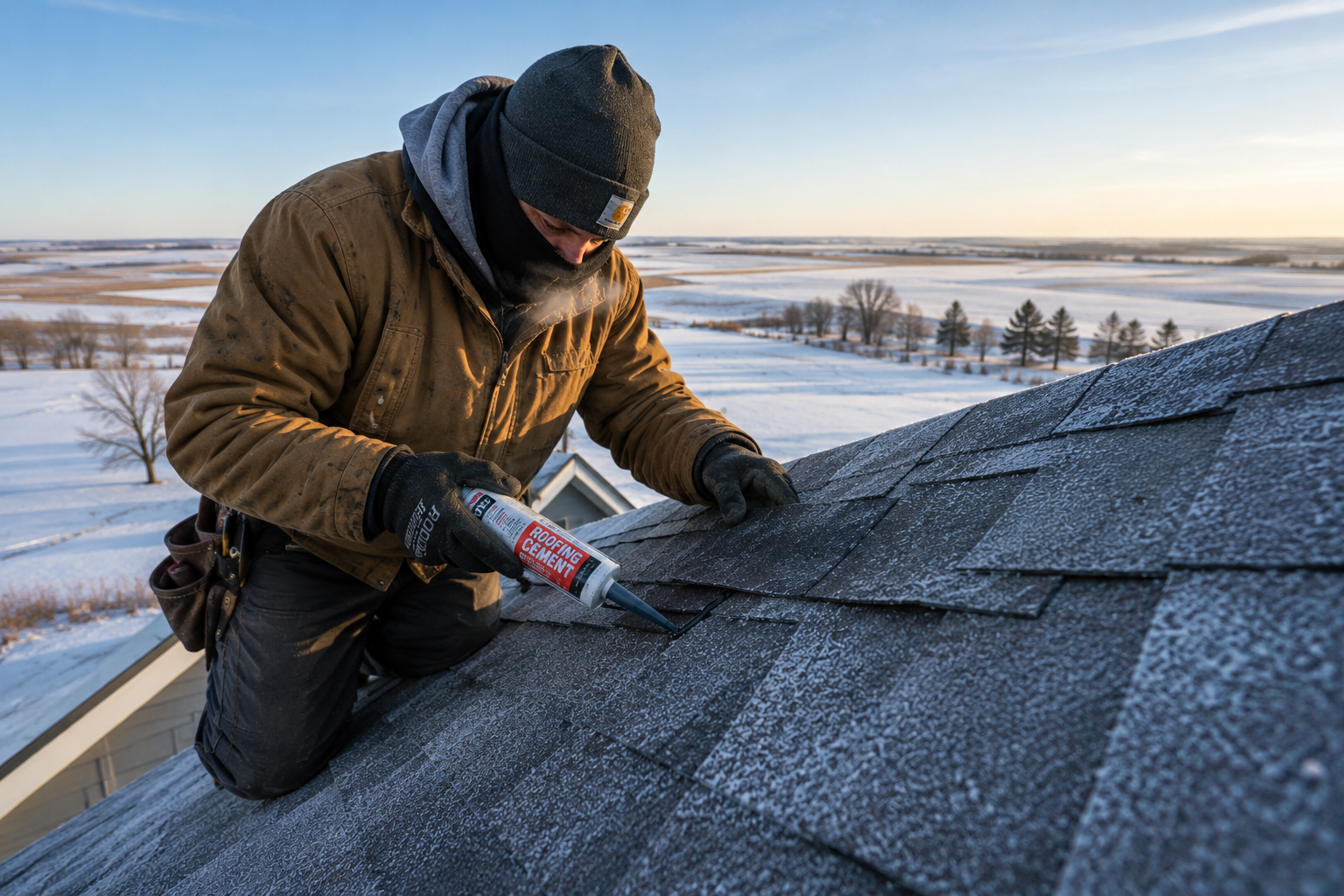
If shingles are installed in late fall or winter, the adhesive strip may never get warm enough to activate before the first windstorm arrives. The roof looks finished. It passes a glance from the ground. But the shingles are only nailed, not sealed.
A good cold-weather roofer knows to hand-seal shingles with roofing cement in vulnerable areas, and to plan the timing carefully. A rushed or cut-rate crew skips this. The result is a brand-new roof that fails in the first moderate wind of the season.
 Nailing: The Number One Installation Mistake
Nail placement sounds like a tiny detail. It is the single biggest reason new roofs fail early.
Every shingle has a marked nailing zone, a reinforced strip where the nail must land. When nails go in correctly, each nail passes through two overlapping layers of shingle, locking the whole system together.
| Nailing Error | What Goes Wrong |
|---|---|
| Nailed too high | Nail catches only one layer, bottom edge free to lift |
| Overdriven (too deep) | Nail head cuts through the shingle, weakens it |
| Underdriven (sticking up) | Stops the shingle above from sealing flat |
| Angled nails | Head sits proud, same problem as underdriven |
| Too few nails | Less holding power, warranty voided |
Most manufacturers require at least four nails per shingle, and six in high-wind zones. A crew moving too fast with a nail gun can miss the zone on many shingles without anyone noticing from the ground. A 150 km/h rated shingle nailed wrong will not survive a 95 km/h gust for long.
Not All Shingles Fail the Same Way
The type of shingle makes a large difference. After one major hurricane, inspectors found that 87 percent of roofs with thicker architectural shingles had little to no damage, while only 44 percent of roofs with thin 3-tab shingles survived as well.
| Shingle Type | Wind Performance | Notes |
|---|---|---|
| 3-tab (thin, flat) | Weakest | More single points to lift |
| Architectural (laminated) | Much stronger | Heavier, better sealed, fewer weak edges |
| Metal (interlocking panels) | Excellent | Panels lock together, high uplift resistance |
| Clay or concrete tile | Strong but conditional | Must be mechanically fastened, not just laid |
The lesson is not that one product is magic. Even the best shingle fails if it is installed wrong. But if you are replacing a roof in a windy region, a quality architectural shingle or a properly installed metal system gives you a real head start.
The Edges Always Go First
Wind damage is not spread evenly across a roof. It concentrates at specific points, and knowing them tells you where to look.
| Roof Zone | Risk Level | Why |
|---|---|---|
| Corners | Highest | Turbulence and peak uplift meet here |
| Eaves (bottom edge) | Very high | Wind gets its first foothold |
| Ridge (peak) | High | Air speeds up and lifts as it crests |
| Rakes (gable sides) | High | Exposed edge, easy to peel |
| Open field (middle) | Lower | Protected by surrounding shingles |
This is why starter strips at the eaves and rakes, and proper drip edge, matter far more than most homeowners realize. They lock down the exact spots where failure begins. Skip them, and you have handed the wind a starting point.
How to Tell If Your Roof Is at Risk
You do not need to climb up to spot trouble. Watch for these signs from the ground or after a windy day.
- Shingles that look creased or have a horizontal line across them
- Curled or lifted corners that do not lie flat
- Shingle pieces or full tabs in the yard after wind
- Granules collecting in gutters or at downspouts
- A roof installed in cold weather that has not seen a warm spell
- A roof older than about 15 years with any of the above
A crease or a curl is not cosmetic. It is an active failure point. Treat it as a repair, not a wait-and-see.
How a Roof Is Built to Resist Wind
Prevention comes down to doing the boring things correctly. Here is what separates a wind-resistant roof from one that fails early.
| Best Practice | What It Prevents |
|---|---|
| Correct nailing zone and count | Uplift and shingle sliding |
| Architectural or metal in windy areas | Early edge failure |
| Starter strips at eaves and rakes | Peeling from the edges |
| New drip edge and flashing | Water paths and edge lift |
| Hand-sealing in cold weather | Unsealed shingles in first storm |
| Balanced attic ventilation | Long-term shingle aging |
None of this is expensive on its own. It is the discipline of a crew that knows the climate and does not cut corners. That is the whole difference between a roof that lasts and one that does not.
Frequently Asked Questions
At what wind speed does roof damage start? On a healthy, fully sealed roof, damage usually needs strong winds. On an aging, unsealed, or poorly installed roof, damage can begin at moderate speeds around 60 to 75 km/h. The condition of the roof matters as much as the wind.
Why did my new roof lose shingles in a small storm? The most likely reasons are that the sealant strip had not activated yet, especially if the roof was installed in cold weather, or the shingles were nailed incorrectly. Both leave the shingles far weaker than their rating suggests.
Are architectural shingles worth it for wind? Yes, in a windy region. Thicker laminated shingles consistently outperform thin 3-tab shingles in wind, as long as they are installed correctly with the right nails and starter strips.
Does cold weather really affect a new roof? It does. Adhesive strips need warmth to bond. A roof installed in cold conditions may stay unsealed until the weather warms, and during that window it is vulnerable to wind. A good roofer hand-seals key areas to bridge the gap.
Can I fix a lifted shingle myself? A single lifted shingle can sometimes be resealed, but creased or torn shingles need proper replacement, and lifting often points to a wider installation issue. A quick professional inspection is the safe call.
How often should I have my roof checked? A yearly visual check and an inspection after any major wind event is a good habit. Catching a broken seal early is far cheaper than repairing water damage later.
Why Trust This Guide
This guide was prepared by the roofing team at Throne Roofing Inc., a licensed and insured roofing contractor working across Alberta and Saskatchewan. Our crews install and repair roofs in one of the windiest, coldest climates in the country, where chinook winds and prairie storms test every seam and fastener. We deal with cold-weather sealing, wind uplift, and edge failures every season, and we install to both building code and manufacturer standards.
If your roof lost shingles in a recent wind, or you want it checked before the next storm, reach out to Throne Roofing for a free, no-obligation inspection and estimate.