
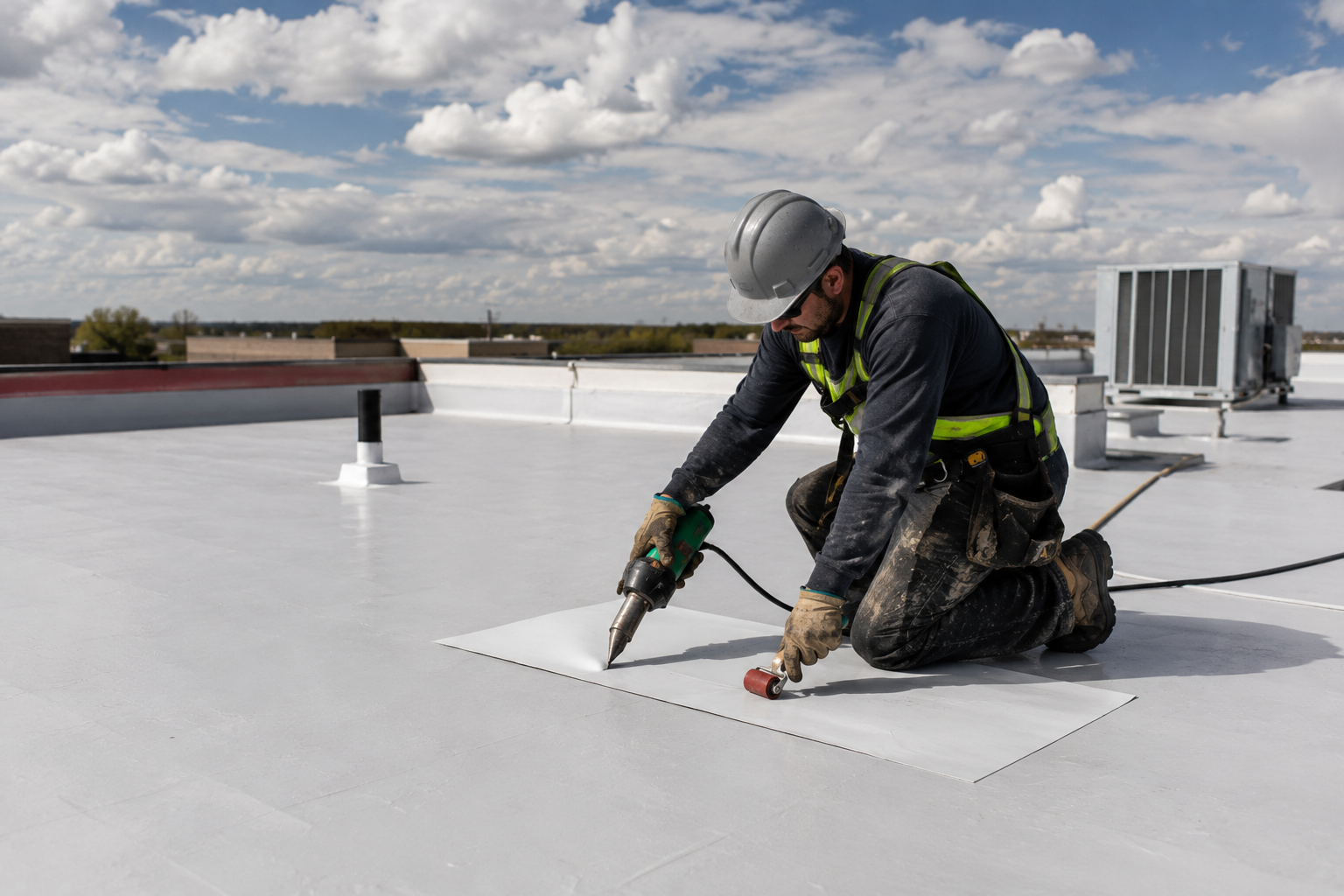
Short answer: Most flat roof repairs come down to five problems: failed seams, punctures in the membrane, flashing that has pulled away, ponding water that will not drain, and blisters caused by trapped moisture. Flashing and seams cause the majority of leaks. A small repair usually costs a few hundred dollars, while larger membrane work runs into the thousands, and the right fix depends on whether you have TPO, EPDM, or torch-on modified bitumen. The one rule that saves the most money: fix a flat roof leak early, because water spreads sideways through the insulation and hides until the damage is expensive.
Flat and low-slope roofs are everywhere in Alberta, on commercial buildings, shops, warehouses, and modern homes. They perform well when maintained, but they fail differently than sloped roofs. Here is how to spot the problem, what it costs, and when repair stops making sense.
The Five Most Common Flat Roof Problems
Nearly every flat roof service call comes back to one of these. Knowing the cause helps you describe the problem and understand the quote.
| Problem | What Causes It |
|---|---|
| Flashing failure | Metal expands and contracts, pulls away from the membrane |
| Seam failure | Poor original weld or bond, thermal cycling, UV aging |
| Punctures and tears | Foot traffic, dropped tools, hail, wind-blown debris |
| Ponding water | Poor slope, clogged drains, sagging deck |
| Blisters and bubbles | Moisture or air trapped under the membrane |
Flashing around pipes, HVAC curbs, and parapet walls is the number one source of leaks, with seam failure a close second. Both are at the joints, not in the open field of the roof. That is why a good inspection focuses on the edges and penetrations first.
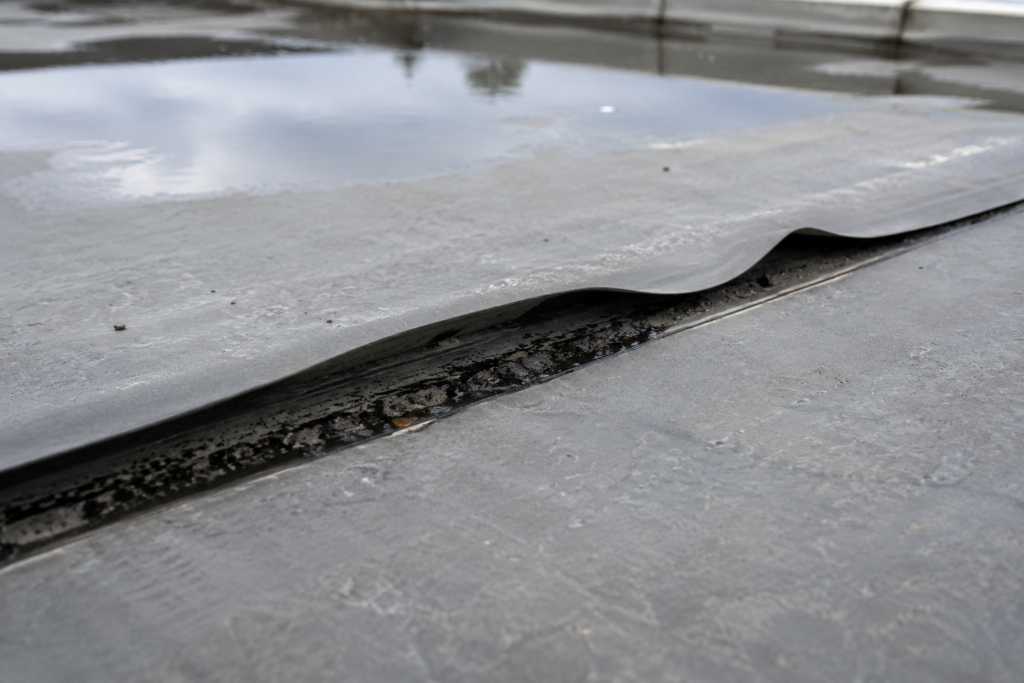 Warning Signs You Should Not Ignore
Flat roof damage often shows up inside the building before anyone sees it on the roof. Watch for these.
- Water stains or bubbling paint on ceilings and walls
- A musty smell in upper rooms or the top floor
- Visible pooling that stays more than two days after rain
- Soft or spongy spots when walking the roof
- Cracks, splits, or lifted edges in the membrane
- Loose or separated flashing around vents and curbs
A single small stain is worth a call. On a flat roof, the leak point is often far from where the water appears inside, because water travels sideways through the insulation before it finds a way down.
Why Flat Roofs Fail Faster in Alberta
The prairie climate is hard on flat roofs in a specific way, and understanding it explains most local failures.
| Climate Factor | Effect on a Flat Roof |
|---|---|
| Freeze and thaw cycles | Expands existing cracks, stresses seams |
| Chinook temperature swings | Rapid expansion and contraction of membrane and metal |
| Heavy snow load | Adds weight, meltwater refreezes at drains |
| Hail | Punctures and bruises membranes |
| Strong UV in summer | Degrades seam adhesive and ages the surface |
A Calgary chinook can swing temperatures dramatically in a single day. That constant movement is what works flashing loose and opens seams over the years. It is also why a repair done properly, with the right material for the temperature, matters more here than in a mild climate.
Repair Methods by Membrane Type
The fix depends entirely on what your roof is made of. Using the wrong method makes things worse.
| Membrane | How It Is Repaired | Notes |
|---|---|---|
| TPO | Heat-welded patch with a hot-air welder | Needs proper weld temperature, not DIY |
| PVC | Heat-welded patch | Same as TPO, specialist equipment |
| EPDM (rubber) | Primer plus adhesive patch or seam tape | Cold adhesive, works in cooler temps |
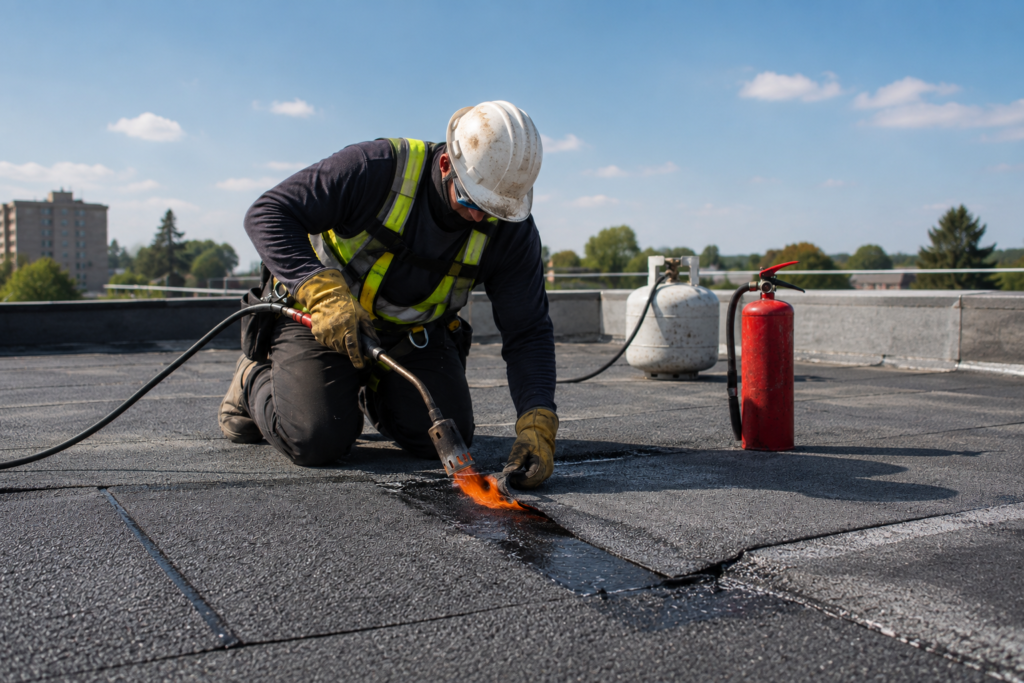
| Modified bitumen (torch-on SBS) | Torch-applied or self-adhesive patch | Very repairable, fire safety critical |
| Built-up roof (BUR) | Asphalt cement with reinforcing fabric | Layered patch over damaged area |
Two practical points. EPDM can be repaired at lower temperatures than TPO, because TPO heat welding gets difficult in the cold, which matters for winter emergency work on the prairies. And torch-on modified bitumen is one of the most repairable systems, but torch work carries real fire risk and belongs with trained crews only.
 What Flat Roof Repair Costs
Costs depend on the membrane, the size of the damage, and access to the roof. These are approximate Canadian ranges to help you judge a quote.
| Repair Type | Approximate Cost (CAD) |
|---|---|
| Seam repair | $300 to $1,200 |
| Puncture or hole patch | $200 to $1,200 |
| Crack repair | $250 to $1,500 |
| Blister or bubble repair | $300 to $1,500 |
| Membrane repair (general) | $300 to $2,000 |
| Larger repair with insulation | $2,000 to $8,000 |
Professional membrane repair often works out to roughly $3 to $10 per square foot depending on the system and complexity. If wet insulation has to come out, cost climbs quickly, which is the main argument for catching leaks early.
Ponding Water: The Problem Behind Many Others
Flat roofs are not truly flat. They are built with a slight slope so water drains. When that drainage fails, water sits, and standing water shortens the life of a membrane significantly.
| Cause of Ponding | Fix |
|---|---|
| Clogged drains or scuppers | Clear and maintain regularly |
| Insufficient slope | Add tapered insulation to redirect flow |
| Sagging or damaged deck | Structural repair beneath the membrane |
| Too few drains | Add drainage points |
Here is the important part: patching a membrane that failed because of ponding, without fixing the drainage, just resets the clock on the same failure. A proper repair addresses the cause, not only the symptom.
Repair or Replace? How to Decide
This is the question every building owner asks. Use these guidelines rather than guessing.
| Situation | Usually Repair | Usually Replace |
|---|---|---|
| Damage is isolated to one area | Yes | |
| Roof is well within its service life | Yes | |
| Leaks keep returning in new spots | Yes | |
| Widespread blistering or cracking | Yes | |
| Wet insulation across large areas | Yes | |
| Membrane is aged and no longer weldable | Yes |
A useful benchmark: when repairs stop holding and you are calling every season, replacement is usually the cheaper path over five years. An honest contractor will tell you when you have crossed that line instead of selling you another patch.
Preventing the Next Repair
Flat roofs reward maintenance more than any other roof type. These steps prevent most failures.
- Inspect twice a year, spring and fall, plus after major storms
- Keep drains, scuppers, and gutters clear of debris
- Install walkway pads where crews access HVAC equipment
- Trim back overhanging branches
- Fix small punctures and open seams immediately
- Keep records of every inspection and repair
Foot traffic causes more membrane damage than most owners realize. Every service technician crossing the roof without walkway pads is a chance for a dropped tool or a ground-in piece of gravel. Pads are inexpensive and prevent a very common leak.
Frequently Asked Questions
What is the most common cause of a flat roof leak? Flashing failure around pipes, HVAC curbs, and parapet walls, followed closely by seam failure. Both are at joints and penetrations rather than in the open membrane, which is where an inspection should start.
Can I repair a flat roof myself? Small EPDM patches are sometimes manageable, since they use cold adhesive. TPO and PVC need heat welding at the correct temperature, and torch-on work carries fire risk, so both belong with a professional. A bad patch often causes more damage than the original leak.
How much does flat roof repair cost? Most repairs run a few hundred to a couple of thousand dollars, roughly $3 to $10 per square foot professionally. Costs rise sharply if water has soaked the insulation below the membrane.
Why does water pool on my flat roof? Usually clogged drains, not enough slope, or a sagging deck. Water that sits more than about 48 hours puts stress on seams and shortens membrane life, so the drainage itself needs fixing, not just the membrane.
Can flat roofs be repaired in winter? Some can. EPDM adhesive repairs work at lower temperatures than TPO heat welding, which becomes difficult in the cold. For an active winter leak, a roofer can usually apply temporary protection and complete a permanent fix when conditions allow.
How long should a flat roof last? It depends on the system and maintenance, but most commercial membranes last two to three decades when installed well, drained properly, and inspected regularly. Ponding water and neglected seams are what cut that short.
Why Trust This Guide
This guide was prepared by the roofing team at Throne Roofing Inc., a licensed and insured roofing contractor serving Calgary, Edmonton, and Saskatchewan. Flat and low-slope roofing is core to our work, including Torch-On SBS, TPO, and single-ply systems on commercial and residential buildings. We repair prairie flat roofs through freeze-thaw seasons, chinook swings, and hail, and we diagnose the cause before we patch the symptom.
Dealing with a leak, ponding water, or a flat roof that keeps needing repairs? Reach out to Throne Roofing for a free, no-obligation inspection and an honest recommendation on repair or replacement.